Good Night Patterns: Seamless Patterns for Professional and Creative Workflows
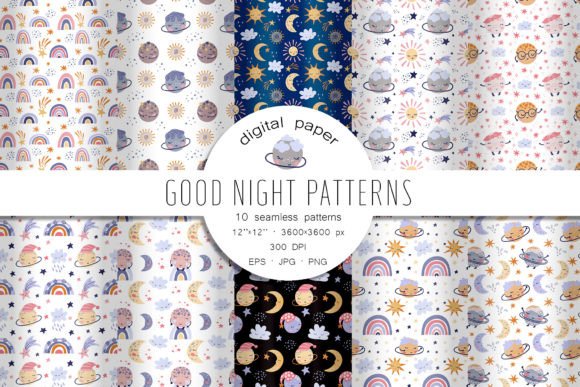
In the realm of digital design and physical product creation, the quality of background assets often dictates the final perception of a project. Good Night Patterns. Seamless Patterns offers a curated collection of high-resolution textures featuring celestial elements like cute planets, moons, clouds, rainbows, stars, and suns. While the subject matter is whimsical, the application of these assets spans a serious range of professional workflows, from textile manufacturing to web interface design. Understanding how to integrate these specific patterns into your existing processes can streamline production, ensure brand consistency, and elevate the visual appeal of your deliverables.
Understanding the Asset Structure and Technical Specifications
Before integrating any digital asset into a workflow, it is critical to understand its technical architecture. The Good Night Patterns set is engineered for versatility, delivered as a ZIP folder containing three distinct file formats: PNG, JPG, and EPS. This multi-format approach addresses different stages of the design lifecycle. The 10 PNG files feature transparent backgrounds at 300 DPI, making them ideal for layering in composite designs where isolation of elements is required. The 10 JPG files provide the seamless pattern itself at 300 DPI with dimensions of 12x12 inches (3600x3600 pixels), ensuring print-ready resolution for large-scale outputs. Finally, the 10 EPS vector files offer scalability without loss of quality, allowing for infinite resizing and color manipulation.
This structure supports a flexible workflow. For instance, a graphic designer might start with the EPS files to customize colors for a specific brand palette, then export to PNG for web use, and finally utilize the high-res JPGs for print production. Having all three formats available eliminates the need for external conversion tools, reducing friction in the production pipeline and minimizing the risk of compression artifacts or resolution errors during the handoff phase.
Integrating Patterns into Textile and Merchandise Production
For professionals in the textile industry, packaging, or merchandise creation, the seamless nature of these patterns is the primary functional value. When designing t-shirts, wallpaper, or fabric prints, the repetition of an image must be invisible to maintain a continuous surface texture. The Good Night Patterns are pre-optimized for this purpose, meaning the edges align perfectly when tiled. This saves significant time in the preparation phase, allowing designers to move immediately to layout and color adjustment rather than troubleshooting alignment issues.
The ability to re-color the pattern using the included vector files is a crucial advantage for brand alignment. A children's clothing line, for example, may require the same star and moon motif but in specific Pantone colors to match their seasonal collection. By utilizing the EPS files, designers can adjust hues globally across the entire pattern, ensuring consistency before sending the file to a printer or manufacturer. This capability transforms a generic asset into a proprietary brand element, enhancing the perceived value of the final product while maintaining strict quality control standards.
Workflow Applications for Digital Designers and Web Developers
In digital environments, such as web design, app interfaces, and marketing materials, these patterns serve as foundational layers that establish mood and theme. The "Good Night" theme, characterized by soft celestial imagery, is particularly effective for applications targeting sleep aids, parenting blogs, educational platforms for children, or bedtime story apps. The high resolution of the 300 DPI JPGs ensures that even when zoomed in on high-density displays, the details of the clouds and rainbows remain crisp.
When implementing these assets into a website, the workflow typically involves selecting the appropriate file size based on performance requirements. While the source files are 3600x3600 pixels, they should be optimized for web delivery to ensure fast load times. Designers can use the PNG versions with transparent backgrounds to overlay icons or text over the pattern, creating depth without obscuring the underlying texture. This layering technique is essential for modern UI/UX design, where flat backgrounds often feel sterile, and textured elements add necessary engagement.
Strategic Use in Print Media and Scrapbooking
For hobbyists, scrapbookers, and small business owners producing physical goods like greeting cards or party decorations, the 12x12 inch dimension of the JPG files is standard for the craft industry. This size aligns perfectly with common paper cutting machines and scrapbook layouts, eliminating the need for complex cropping or scaling calculations. The inclusion of cute elements like suns and rainbows provides immediate thematic cohesion for projects focused on childhood milestones, nursery decor, or educational materials.
Efficiency in print workflows relies heavily on file readiness. Since the Good Night Patterns come pre-packaged and organized, users can bypass the time-consuming search for compatible assets. This allows creators to focus on composition and storytelling within their projects. Whether printing a single invitation or running a batch of party banners, the consistent quality of the 300 DPI files ensures that the output matches the digital preview, reducing waste and reprint costs.
Optimizing Organization and Long-Term Asset Management
Effective integration of digital assets requires a robust organizational strategy. Upon downloading the ZIP folder, it is best practice to extract the files into a structured directory system. Separating the vector EPS files from the raster JPG and PNG files allows for quick access depending on the immediate task. For long-term use, renaming files to include specific color variations or modification dates can prevent confusion in future projects.
Furthermore, understanding the licensing and intended use cases is part of the planning process. These patterns are suitable for both personal and professional use, including commercial products like t-shirts and packaging. However, documenting how and where these assets are used helps in maintaining clear records for client billing or inventory management. By treating these patterns as core components of a design library rather than one-off images, businesses can build a cohesive visual identity across various touchpoints, from digital ads to physical retail displays.
Enhancing Creativity Through Customization and Adaptation
The true power of the Good Night Patterns lies not just in their ready-to-use state, but in their adaptability. The vector format invites experimentation. Designers can isolate specific elements—such as a single moon or cloud—and combine them with other assets to create unique compositions. This modularity supports iterative design processes where concepts are tested and refined before final execution.
For educators and content creators, these patterns can be repurposed to create interactive learning materials. The recognizable shapes of planets and stars can be used in worksheets, flashcards, or digital games designed to teach astronomy or basic counting. The ability to re-color these elements means they can be adapted for different age groups or accessibility needs, such as increasing contrast for visually impaired users. This flexibility extends the lifecycle of the asset, ensuring it remains relevant across multiple projects and contexts.
Conclusion on Implementation and Value
Good Night Patterns. Seamless Patterns represents more than just a collection of cute images; it is a functional tool designed to fit seamlessly into diverse creative and business workflows. From the initial planning stage of a textile run to the final export of a web background, the technical specifications and format variety ensure that the asset meets rigorous professional standards. By leveraging the vector capabilities for customization and the high-resolution raster files for print and display, users can achieve consistent, high-quality results efficiently. Integrating these patterns into your design ecosystem enhances productivity, reduces technical overhead, and provides a versatile foundation for bringing imaginative concepts to life.